

Current location: home page > Products > Buried composite pipe for gas stations
Brief description:The bottleneck of the service life of buried pipelines in gas stations lies in electrochemical corrosion. Composite pipes use non-metallic isolated corrosive media, which have the advantages of leakage monitoring and installation efficiency. This article explains the selection logic and construction points.
 News
Why choose composite pipes for gas station pipeline renovation? Direct answer: The number one failure mode of buried pipelines is corrosion and leakage - steel pipelines, under the action of soil electrochemical corrosion and stray currents, will first rot at welds and defect areas, leak and pollute groundwater, and then shut down for rectification, resulting in losses far exceeding the price difference of the pipes. The non-metallic layer of composite pipes isolates the corrosive medium from the metal and eliminates this failure path from the root; The gap between the double-layer structure can also be used for leakage monitoring, allowing for early detection of leaks. Transforming windows is already rare, and solving the lifespan issue of pipelines in one go is more cost-effective than repeatedly repairing leaks. This article explains the selection logic and construction points.
The failure of buried steel pipelines follows a clear pattern: corrosion occurs first at points of damage to the anti-corrosion layer, welding defects, and stress concentration; Areas with high soil moisture and salinity progress faster; The stray currents generated by surrounding subways and electrified facilities will accelerate local corrosion. The cost of leakage is divided into three layers: direct loss of oil products and closure for rectification, indirect responsibility for soil and groundwater remediation, and long-term operational risk of the site. Adding cathodic protection to the anti-corrosion layer can delay, but it cannot change the trend of continuous thinning of the metal; Testing can detect early thinning, but cannot prevent sudden leakage. The essence of selecting materials for pipeline renovation is to choose a path with a lower probability of failure.
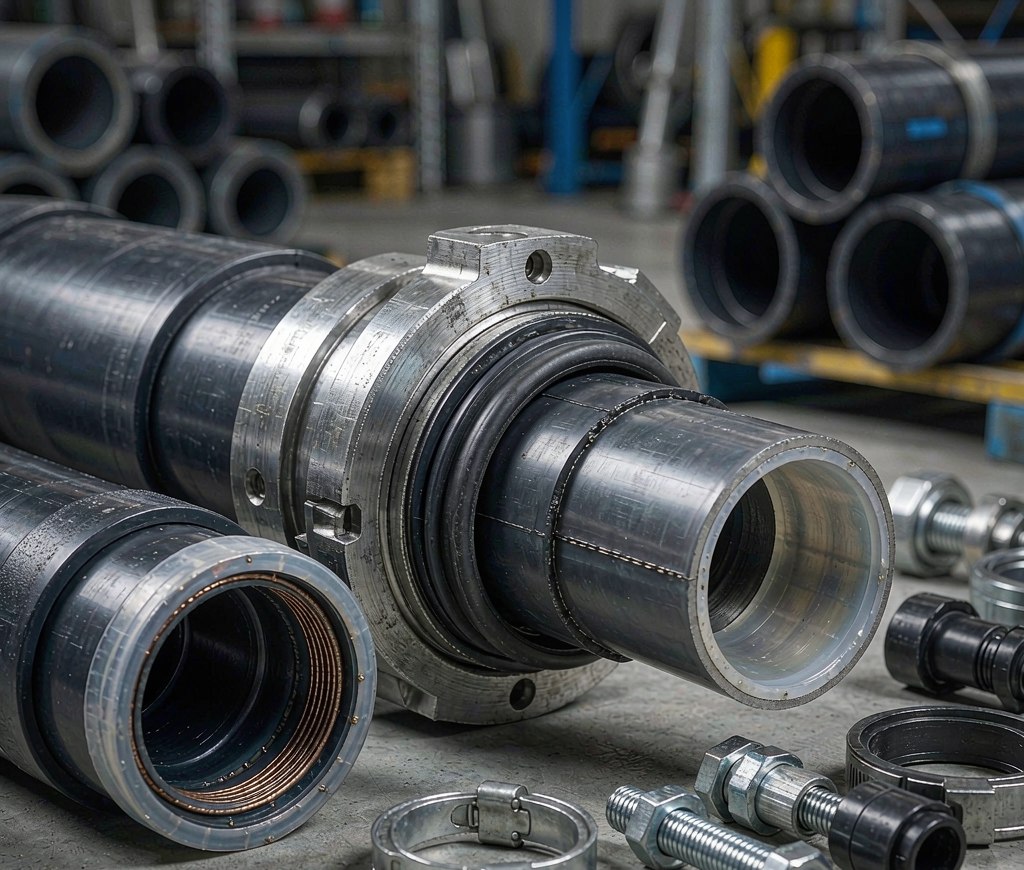
The idea of composite pipes is to use structure to replace life: non-metallic materials on the inner and outer layers isolate the soil from the medium, while the metal reinforcement layer only bears mechanical loads and does not come into contact with corrosive environments; The interlayer gap of double-layer composite pipes can also be equipped with leakage monitoring lines, which can alarm in advance when leakage occurs, turning post repair into pre disposal. The friction coefficient of non-metallic inner walls is lower than that of steel pipes, resulting in lower conveying resistance under the same pipe diameter; Lightweight, short excavation and lifting time, and friendly to the renovation window of the business station. The joint is connected to the flange by electric melting, and the on-site operation is less than that of the welding interface. The quality consistency is guaranteed by the process parameters and does not depend on the welder's hand feel.
Comparison should be comprehensive: the initial investment of composite pipes is higher than that of ordinary steel pipes, and lower than that of steel pipe systems with complete anti-corrosion and cathodic protection; In terms of service life, steel pipes are typically designed to last for over ten years with accompanying testing and maintenance, while composite pipes are typically designed to last for several decades with minimal corrosion related maintenance during the process; Installing composite pipes is fast, steel pipes are slow, but the maintenance team is familiar with them; Double layered composite pipes have inherent advantages in monitoring, and steel pipes rely on external testing for supplementation. The comprehensive account is calculated based on the entire cycle, and the more difficult it is to renovate the window, the more obvious the advantages of composite management. When selecting, check the material certification and testing report, and determine the specifications according to the medium and burial depth inside the station.
| Comparison item | Steel pipeline | Double layered composite pipe |
|---|---|---|
| Main cause of failure | Electrochemical corrosion leakage | Non metallic isolation does not have this path |
| connection method | welding | Electric melting and flanges |
| Leakage monitoring | Relying on external inspection | Inter layer monitoring line |
| Hydraulic performance | High inner wall friction | Low friction and low resistance |
| Installation efficiency | Slow dependence on welders | Fast process parameterization |
| Full cycle cost | Continuous investment in testing and maintenance | Basic corrosion free maintenance |
Can: The metal reinforcement layer bears the internal pressure load, and the specifications are calculated based on the design pressure and test pressure when selecting, while the manufacturer calculates the ratio according to the working conditions; The key is to check the specifications and pressure rating, and do not connect low-pressure pipes to high-pressure working conditions.
The monitoring line installed in the interlayer gap comes into contact with the leakage medium when a leak occurs, and the signal changes are transmitted to the station alarm host; It is much earlier than manual inspection, especially for slow seepage, which can save time for planned disposal and avoid sudden closure.
It is possible, but insulation transition should be done: the connection between the new and old pipes should be isolated with an electric melting flange and insulation components to avoid electrochemical corrosion concentrated in the transition section; The construction quality of transitional components should be inspected with emphasis, as this is precisely the high-risk area for the failure of new and old systems.
This article is organized by Luoyang wohong petrochemical equipment co., ltd. the company provides design, manufacture, installation, commissioning and operation and maintenance services for oil and gas recovery equipment, solvent recovery devices and buried composite pipe networks at gas stations, oil depots and chemical enterprises. if you need scheme configuration or on-site investigation, please contact and exchange.
 Previous articleHow to make the joint of composite pipe? Connection process and sealing closed-loop requirements
 Company Name:
Luoyang Wohong Petrochemical Equipment Co., Ltd
 Hotline:
13526990215
 Company Address:
W2-1, Dongda Technology Industrial Park, Luoxin Industrial Cluster, Xin'an County, Luoyang City
 E-mail
lixiang@vohonoilpipe.com

Scan to follow us
Luoyang Wohong Petrochemical Equipment Co., Ltd Powered by EyouCms Henan ICP Registration No. 17014668-11 sitemap.xml
 Product Category