

How to choose organic vapor recovery membrane components? Membrane structure, applicable medium, and key points of operation and maintenance
Release time: 2026-10-06
View count:
The organic vapor recovery membrane module is the core component of the membrane recovery device. Selection is not about choosing a single membrane, but rather selecting a set of membrane layer structures and process conditions that match the medium, gas volume, and concentration. Storage tank breathing gas, loading platform exhaust gas, and propylene and vinyl chloride recovery in chemical plants all use the same type of rubber-like separation membrane, but the module area, number of stages, and pre-treatment configuration vary. By understanding the membrane layer structure and clarifying the applicable boundaries, selection and operation and maintenance will not take detours.
What is the structure of a membrane
Commercial organic vapor membranes are three-layer composite structures: the surface layer is a separation layer made of rubbery polymers, with the main material being silicone rubber. This layer features soft molecular segments and large free volume, exhibiting high solubility for organic vapors and serving as the truly active layer for dry separation. The middle layer is a solvent-resistant porous support membrane, providing strength to the separation layer and resisting solvent swelling. The bottom layer is a nonwoven fabric, serving as a mechanical carrier for easy rolling or stacking into components. Component forms include stacked, rolled, and hollow fiber types. Stacked components feature a short permeate flow path, low resistance, and no electrostatic accumulation during operation, making them more stable for hydrocarbon-containing gas mixtures.
What media can be collected
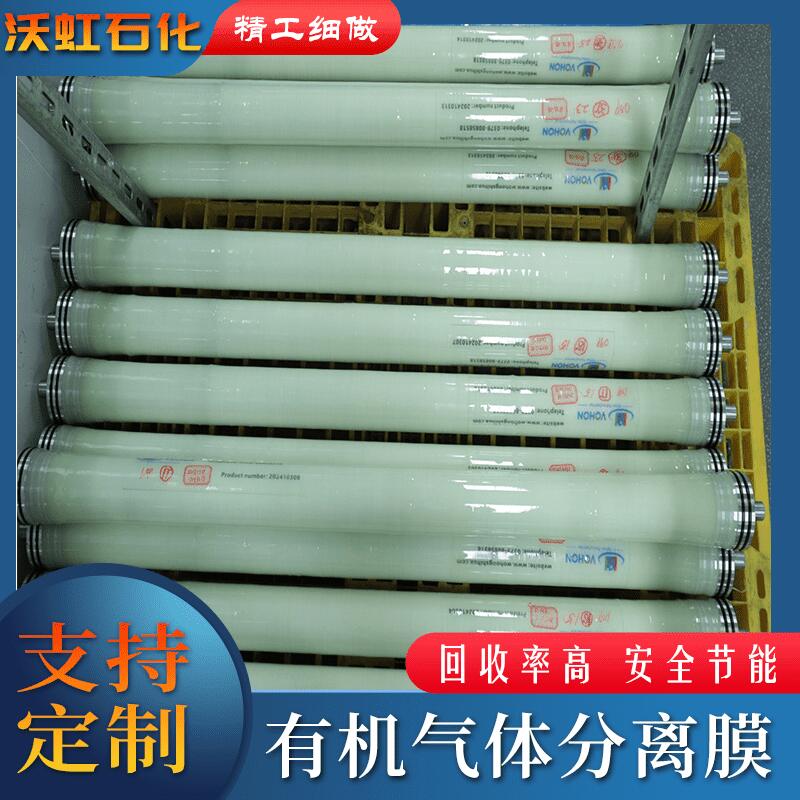
Rubber-state membranes are effective against most organic vapors: alkanes and alkenes such as gasoline vapor and hexane; aromatic hydrocarbons such as benzene, toluene, and xylene; alcohols, ketones, esters, and ether solvents; and halogenated hydrocarbons such as dichloromethane and vinyl chloride are also within the scope of application. Typical scenarios include tank breathing gas recovery, oil depot loading platform oil and gas recovery, polypropylene plant tail gas propylene recovery, and fluorine chemical monomer recovery. It is important to note the boundary conditions: when the tail gas contains particulate matter, liquid droplets, or high humidity, pretreatment is required. The cleaner the filtration and dehumidification before the membrane, the longer the performance of the separation layer will be maintained.
Before selecting a model, consider three accounts: one is the medium account - the dominant component, concentration range, and humidity level determine the membrane area and pretreatment configuration; one is the recovery account - the value and recovery amount of recoverable components determine the upper limit of investment; and one is the operation account - the power consumption for pressurization and vacuum, and the periodic investment in filter materials and membrane layers, calculated on an annual basis. All three accounts are based on actual measured data, so that the selected configuration will not require rework. Empirically, media with high concentration and high value are preferred for membrane treatment, while in scenarios with low concentration but high environmental pressure, a combination of membrane and adsorption is more cost-effective.
What to consider when selecting a model
| Structural layer | Material and form | effect |
|---|---|---|
| Separation layer | Rubber-like polymer | Selective layer for dissolution and diffusion |
| support layer | Solvent-resistant porous membrane | Provide strength and resistance to swelling |
| bottom layer | Nonwoven fabric | Mechanical carrier |
| component | Stacked or rolled | Low laminated resistance and no static accumulation |
| Preprocessing | Filtration and dehumidification | Protective separation layer |
| monitoring | Pressure difference and vacuum degree | The prerequisite for stable voltage operation |
How to extend the lifespan through operation and maintenance
- The pre-treatment filter material is replaced based on pressure difference to prevent liquid droplets and particles from reaching the membrane surface;
- Maintain stable flow and pressure of the feedstock to avoid sudden pressure changes that could impact the separation layer;
- Record the trends of pressure difference, vacuum degree, and permeate side flow rate daily;
- Pre-dehumidification under high humidity and high temperature conditions, with a focus on the temperature before the membrane in summer;
- The performance is calibrated on a quarterly basis. If there is a decrease in throughput, first check the pretreatment and vacuum systems;
- Long-term shutdown requires purging and sealing as required, and performance calibration should be conducted before resuming operation.
Frequently Asked Questions
How many years can the membrane last?
The lifespan is directly related to the cleanliness of the medium, the level of pressure stabilization, and the quality of inspection: devices with proper pre-treatment and stable pressure difference can maintain membrane performance over a long period. If there is a decrease in flux, first check the pre-treatment and vacuum system, and only then evaluate the membrane itself.
Can high-humidity exhaust gas enter the membrane directly?
It is recommended to first remove moisture. The condensation of moisture and condensate on the membrane surface will affect the separation performance. In high-humidity conditions, a dehumidification section should be set up before the membrane, especially in high-temperature and high-humidity areas in summer. The investment in this section will be repaid in multiplying the lifespan of the membrane.
Is it cost-effective to use membranes for treating exhaust gas with very low concentration?
When the concentration is too low, the cost-effectiveness of the membrane decreases. It is advisable to concentrate the gas first and then pass it through the membrane, or combine it with adsorption. The recovery value should be calculated based on the measured gas volume and concentration data before deciding on a plan. Do not rely on intuition when selecting equipment.
This article is compiled by Luoyang Wohong Petrochemical Equipment Co., Ltd., which provides design, manufacturing, and operation and maintenance services for condensation recovery, membrane separation recovery, and complete solvent recovery equipment to chemical and pharmaceutical enterprises. If you need process evaluation or scheme configuration, please feel free to contact us for discussion.