

How to treat solvent tail gas in laboratories and pilot workshops? Collection and treatment configuration for low air volume and high concentration conditions
Release time: 2026-09-27
View count:
The solvent exhaust gas in the laboratory and pilot workshop exhibits significant differences in operating conditions and production equipment: there are numerous and dispersed emission points - such as fume hoods, reaction kettle exhausts, and vacuum pump outlets; the air volume at a single point is small, typically ranging from tens to hundreds of cubic meters per hour; and the concentration fluctuates greatly, changing with each batch of experiments. It is evidently uneconomical to configure a large device based on the production equipment approach. The treatment configuration needs to be reconsidered according to the operating conditions of low air volume.
The governance value of such conditions lies in compliance and personnel protection: despite the low concentration, when emissions are directly discharged outdoors or indoor circulation is poor, both the boundary and indoor air quality may be compromised. Centralized collection and subsequent treatment is the practical choice for most factories. When configuring, personnel safety should be prioritized: indoor concentration and exhaust efficiency take precedence over the economics of recycling, with recycling being a side benefit.
How to collect
Collection can be divided according to the nature of the points: emissions from fume hoods and exhaust hoods are each collected through separate pipes and merged into branches; points with high concentrations such as vacuum pump outlets and reaction kettle vents are collected separately for priority recovery. In terms of pipeline design, the number and length of branches should be controlled. Small air volume systems have a high proportion of pipeline resistance, and if there are too many branches connected in series, the end points will not be able to pump effectively, and the collection effect will start to fail from the end points.
The margin of the fan is reserved based on system air leakage and future expansion: as the points in the pilot workshop are often added, one or two branch interfaces are reserved, which is more convenient than temporarily modifying the pipeline. The pipe diameter of the branch is determined based on the air volume at the point, without uniform amplification: a branch with a larger pipe diameter has a lower flow rate, and the solvent condenses and accumulates in the pipe, which in turn brings about corrosion and cleaning burdens.
How to handle the configuration
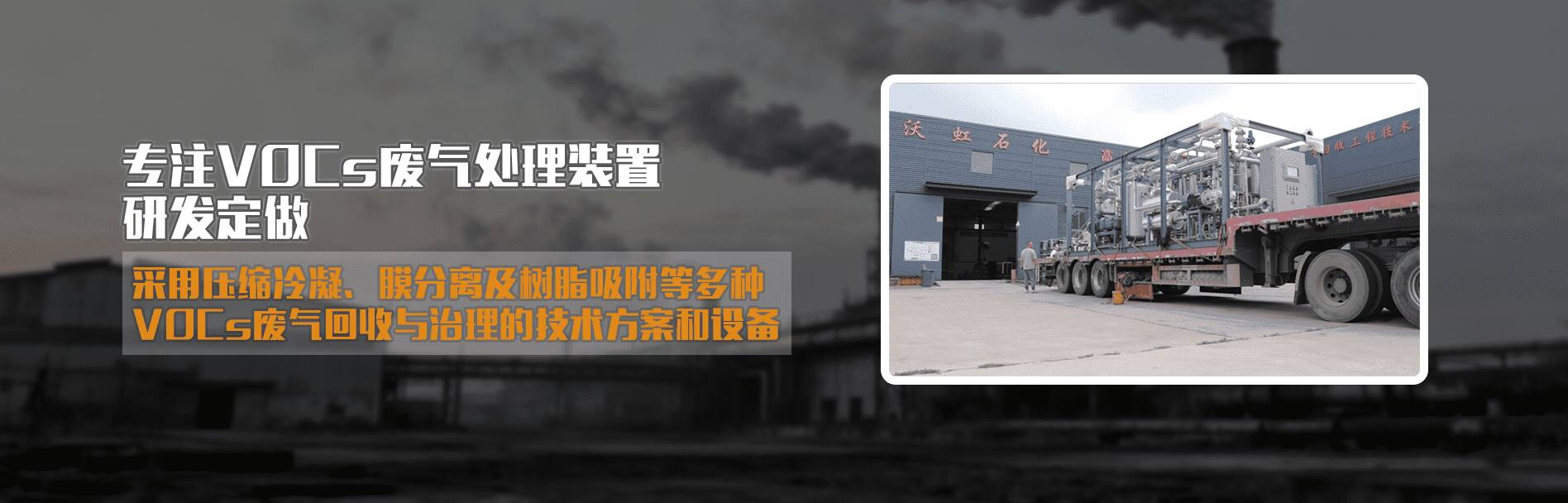
The treatment sequence for points with low air volume and high concentration: first, condense and recover, then proceed to the control section after the concentration is reduced. For the control section, select activated carbon adsorption or small membrane separation based on the air volume. The activated carbon box should be made into a replaceable standardized box, and after saturation, the entire box should be replaced for regeneration, without desorption on site. After collecting the condensed liquid, it should be returned to the solvent recovery system or entrusted for treatment, depending on the amount of solvent content.
For pure low-concentration exhaust gas with both low concentration and low air volume, direct carbon adsorption is sufficient without the need for condensation - the simpler the device, the greater the likelihood of consistent operation.
The footprint and noise of processing equipment are also constraints in the pilot building: the units should be placed on the roof or in equipment rooms as much as possible, fans should be provided with vibration reduction and noise elimination measures, and pipe penetrations through walls should be sealed and fireproofed. These details should be confirmed during the selection phase, which is more convenient than making modifications after installation.
Selection and configuration reference
| Point Type | Concentration characteristics | Handling arrangement |
|---|---|---|
| Ventilation cabinet exhaust | Low-concentration intermittent | Integrate into the main pipe for carbon adsorption |
| Emptying the reaction kettle | High concentration fluctuation | Condensation recovery takes priority |
| Vacuum pump outlet | High concentration and stability | Single branch condensation |
| Purging and replacement | Instantaneous high concentration | Temporary collection hose |
| Carbon box inspection | low concentration | Standardized container exchange and recycling |
| Condensate | solvent-containing | Collect and match the transfer ledger |
How to implement operation management
- Register and document emission points, specifying the collection methods and branch attribution for each point;
- The branch air valve is controlled by the test switch, and the branch at the deactivation point is closed to prevent short circuits;
- The carbon box and membrane components should be replaced based on pressure difference or time, and the replacement records should be retained;
- The condensate collection container is regularly transferred, and the ledger is matched with the destination documents;
- Monitor the air quality at the factory boundary and indoors on a quarterly basis, with a focus on investigating points where there are abnormally high levels.
Frequently Asked Questions
What if there are too many points and the total collection pipeline is too long?
Zoned collection: Set up two or three small units according to buildings or areas, with each unit managing its own zone. The length of the pipeline can be controlled, and the start and stop of the units are also flexible. The approach of using a large system to serve the entire building often results in poor terminal effects.
What should we do about solvent changes and processing configuration in pilot-scale products?
Select the solvent with the strongest volatility and the lowest boiling point among commonly used solvents to verify the condensation temperature level, and adjust the temperature level setting as needed when changing products. In workshops where solvent changes are particularly frequent, the versatility of the control section is more important than the accuracy of the condensation section.
How often should the carbon box be replaced?
Observe the two indicators: pressure difference and outlet concentration. If the pressure difference increases significantly or the detected outlet concentration rises, arrange for a cartridge change. The periodicity determined based on these two indicators is more accurate than the fixed periodicity. The replaced carbon cartridge should be handed over to the regeneration unit for disposal.
This article is compiled by Luoyang Wohong Petrochemical Equipment Co., Ltd., which provides design, manufacturing, and operation and maintenance services for condensation recovery, membrane separation recovery, and complete solvent recovery equipment to chemical and pharmaceutical enterprises. If you need process evaluation or scheme configuration, please feel free to contact us for discussion.